Electrical & Lighting

Dual AGM Setup & Isolator Wiring

Batteries and electricity are the foundation of any offroad vehicle. Whether it's starting your rig, running a winch, or powering lights — a solid power source is essential.

Choosing the Right Battery

If you've ever bought a battery you know they come in all shapes, sizes, and styles. So what's best for your rig? As always, the answer is "it depends."

If you plan on running a winch, you're going to want a battery with lots of storage capacity. Live in cold weather? That's also a contender for a large battery.

Typically you want the largest battery you can afford and that will fit in your rig.
Battery Types

Batteries come in three typical types. Here's a breakdown of each.

Flooded Lead Acid

The conventional battery that most people have in their cars. Also the least expensive option, but requires the most maintenance and has the shortest life span.

Pros

  • Cost effective
  • Readily available

Cons

  • Can spill if not kept upright
  • Generates corrosion on the terminals
  • Water level inside must be maintained
  • Shortest life span
  • Doesn't handle freezing temps well

AGM (Absorbed Glass Mat)

Similar to a lead acid battery but doesn't contain liquid acid — just a mat soaked in acid (think of a wet sponge). More expensive than lead acid but with a longer life span.

Pros

  • Can be mounted in any position
  • Can be frozen with little effect on performance
  • Requires no maintenance
  • Does not create corrosion on the terminals

Cons

  • More expensive than lead acid

Lithium

The most expensive option, but can be drawn down very low with minimal effect on the battery. A strong choice if weight and deep discharge are priorities.

Pros

  • Can be drawn down very low without harm
  • Lighter weight compared to AGM or lead acid
  • Charges faster

Cons

  • Most expensive
  • Doesn't handle freezing temps very well

My Dual AGM Setup

How I Run It

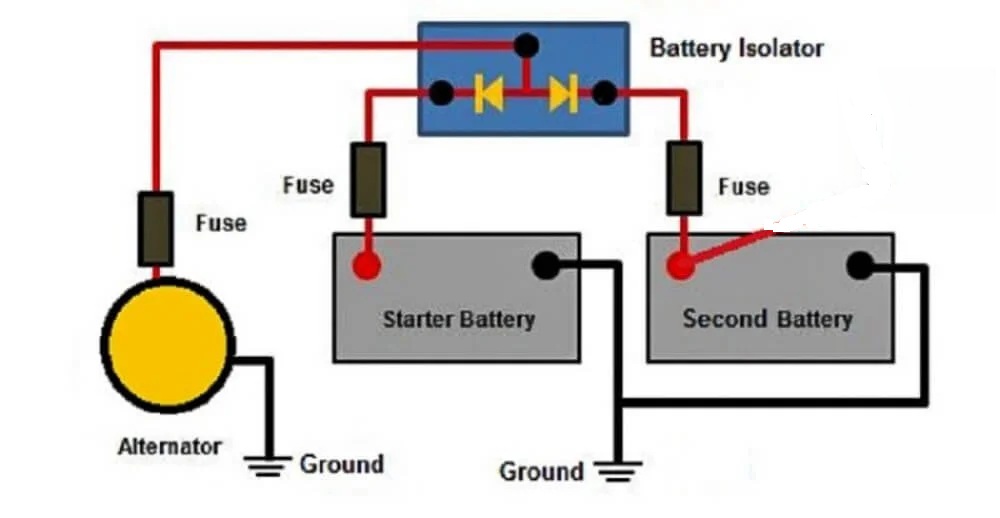
I personally run two large AGM batteries in my wheeler — one in front and one in back, with a winch connected to each. I have a dual battery isolator connecting them to control charging.

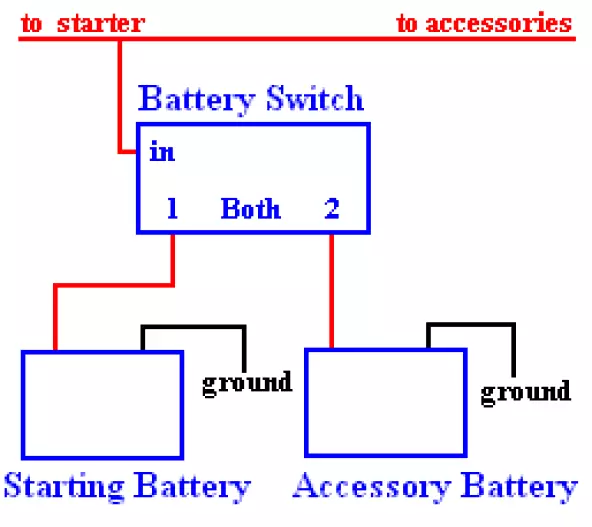
I run my main harness off the front battery, but I have a switch that allows me to switch over to the rear battery in the event the front one gets run down — giving me a backup of sorts.

I have run this setup for several years now without issue.

Note: In a dual battery setup, it is best to run matching batteries.

Wiring Diagrams

Below are typical wiring diagrams for a dual battery setup. Click to open full size.